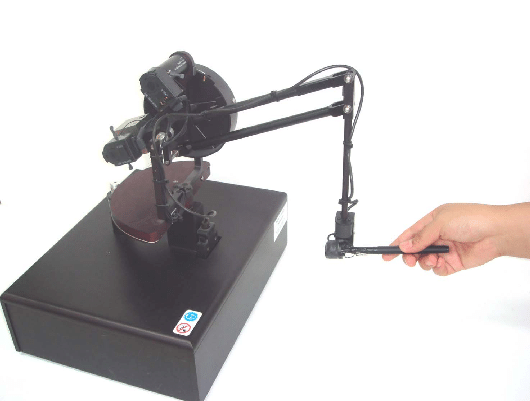
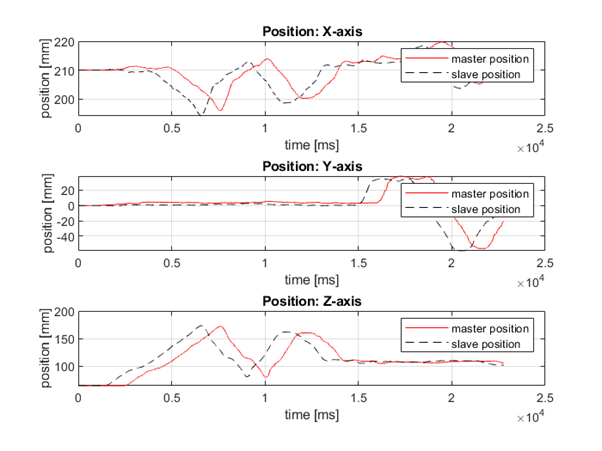
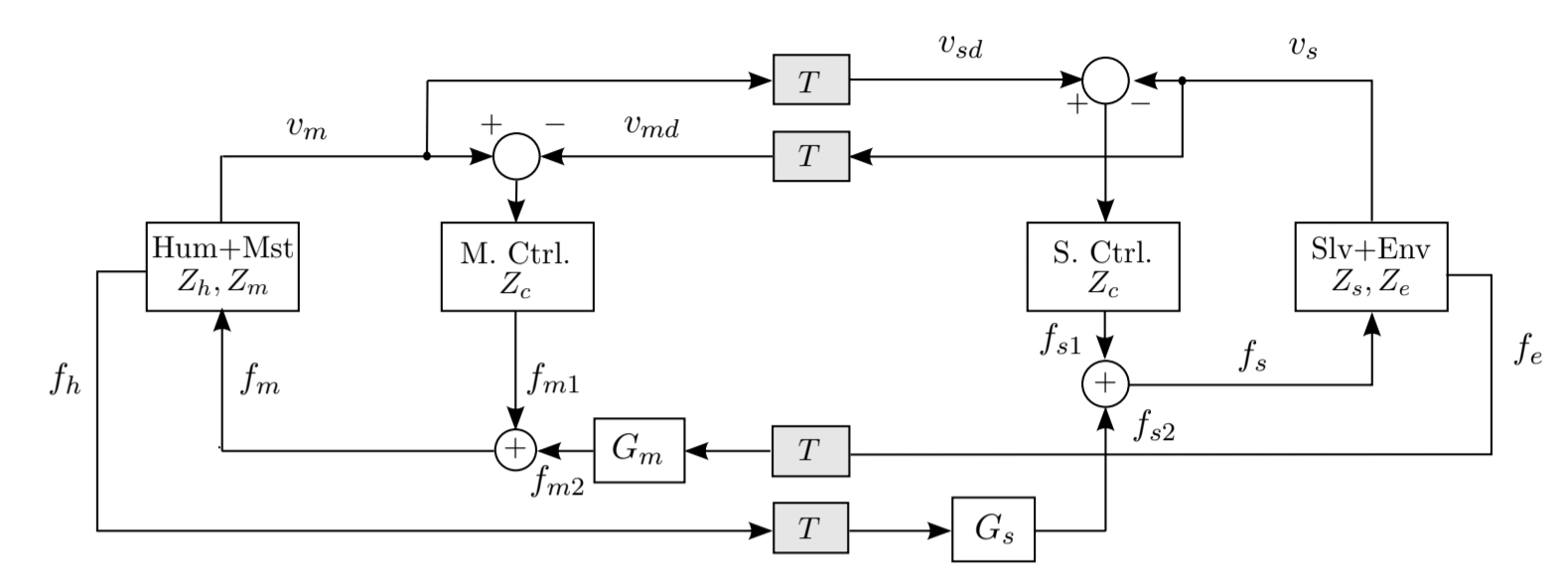
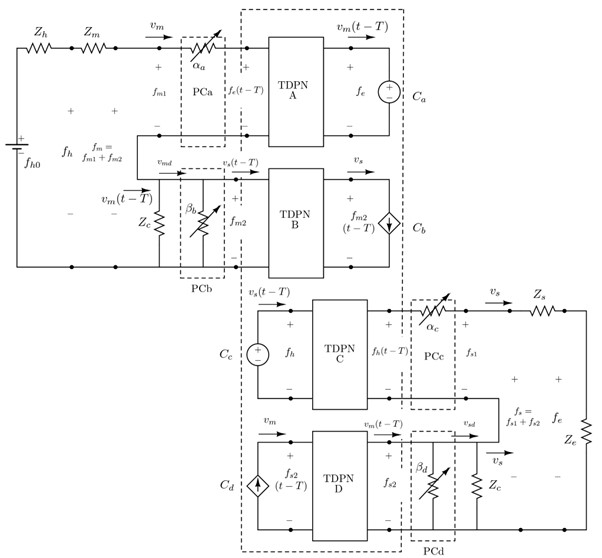
In this project I implemented parallel force and position control for bilateral teleoperation with time delay. A communication delay between master and slave – introduced artificially here – destabilises a conventional teleoperation controller, as shown in many publications. I therefore used a passivity-based approach to keep the system stable.
I did this as a voluntary project in Prof. Jee-Hwan Ryu's laboratory at KAIST in Daejeon, South Korea, during my exchange semester. The controller shown in the video below is an adaptive inverse-dynamics controller. It provides stable force and position control in both directions (master ↔ slave).
Besides the teleoperation control, I also implemented and tested impedance control, Slotine–Li adaptive control and sliding-mode control.
Artigas Esclusa, J. (2014). Time domain passivity control for delayed teleoperation [PhD thesis]. elib.dlr.de/113216
Farkhatdinov, I., & Ryu, J.-H. (2007). Hybrid position-position and position-speed command strategy for the bilateral teleoperation of a mobile robot. 2007 International Conference on Control, Automation and Systems. doi:10.1109/ICCAS.2007.4406773
Ildar Farkhatdinov and Jee-Hwan Ryu (2007) ‘Hybrid position-position and position-speed
command strategy for the bilateral teleoperation of a mobile robot’, 2007 International Conference on Control, Automation and Systems [Preprint]. doi:10.1109/iccas.2007.4406773.